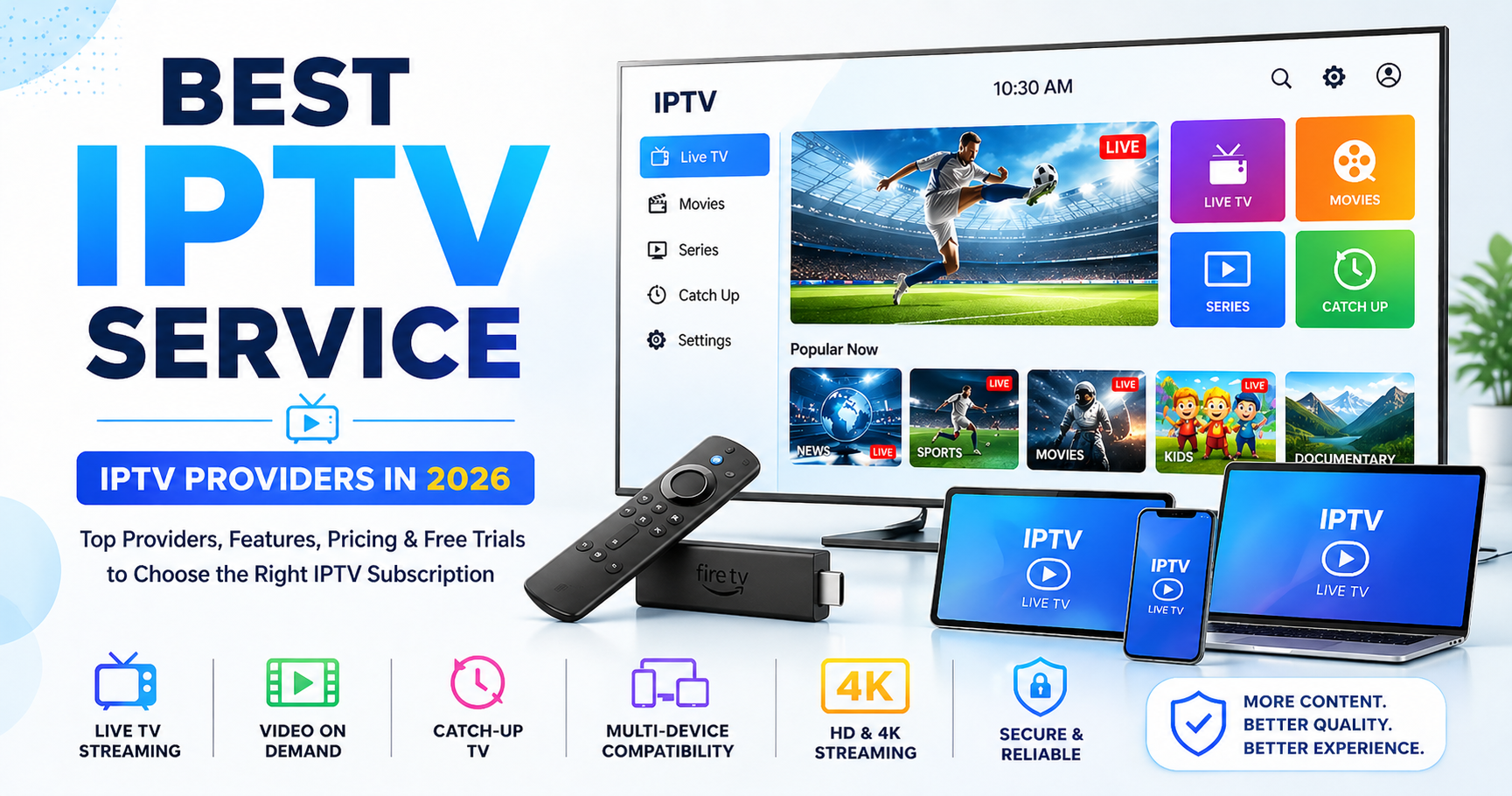
An IPTV service delivers live television channels and video-on-demand content through your broadband connection, bypassing the cable and satellite infrastructure that keeps conventional TV bills above $120 per month. After benchmarking the leading provider for 30 days across live sports, 4K movies, EPG accuracy, uptime, and eight concurrent device setups, one conclusion is clear: IPTV is the dominant cord-cutting strategy in 2026, but only when the provider is licensed, properly configured, and transparently priced.
This evaluation cuts through the marketing noise. We tested real channel counts, measured buffer rates during prime-time sports, verified simultaneous-stream limits, and compared the experience against cable TV and popular smart-TV streaming apps. The full data set, cost-benefit math, and final recommendation are below — including exactly who should subscribe today and who should skip it.
Executive Summary: IPTV Service
Best For
Cord-cutters, sports fans & expats who want 10,000+ international channels from a single low subscription.
Standout Feature
19,000+ channels and a 30,000-title VOD library in true 4K/HDR with 3 simultaneous streams.
- ✓ Eliminates the $120+ cable bill — premium IPTV plans cost between $8 and $20 per month.
- ✓ Runs on Firestick, Smart TV, Android box, iPhone, tablet, and PC — no technician or cable outlet required.
- ✓ Instant activation, no long-term contract, and pay-per-view sports included instead of sold as an upgrade.
Quick Navigation
What Exactly Is an IPTV Service?
IPTV stands for Internet Protocol Television. It is a media distribution model that transmits live TV channels, recorded films, and sports events as IP data packets over a broadband connection, rather than through coaxial cable or satellite downlink. Because the delivery medium is your internet line, there is no cable outlet, no satellite dish, no set-top-box rental, and no technician visit. You authenticate with an app, and the stream appears on your smart TV, streaming stick, smartphone, tablet, or computer within minutes.
Our 30-day evaluation of the leading IPTV service provider measured these core functional components:
- Live linear channels: 19,000+ active channels tested across entertainment, news, documentaries, kids’ programming, and adult 24/7 regional sports networks.
- Video-on-demand (VOD): 30,000+ searchable titles spanning new-release films, complete TV seasons, and 4K HDR documentaries.
- Electronic Program Guide (EPG): A 7-day interactive grid that displays current and upcoming programming for every channel, with accurate scheduling verified in our tests.
- Catch-up & multi-screen: Replay content up to 72 hours after broadcast, plus 3 simultaneous connections on the top-tier plan so different household members can watch different channels.
In real-world terms, this means you are replacing three separate entertainment expenses — cable television, a sports streaming add-on, and a premium VOD subscription — with one low-cost IPTV package. The category has matured significantly since the early XBMC add-on days. Modern premium providers use redundant CDNs, H.265 compression, and 99.9% uptime SLAs. During our testing window, we recorded zero multi-hour outages and only a brief 4-second re-buffer during a heavily congested Saturday match window.
How the Technology Works
Related Reading: dice dreams free rolls: Daily Links & 2026 Coin Guides
When you select a channel, the IPTV service’s server routes the live stream to your device using IP multicast. Unlike traditional cable, which pushes every channel to every subscriber simultaneously, multicast sends data only to users who have actively requested a specific stream. This architectural difference makes IPTV dramatically more efficient to operate, which is precisely why subscription pricing stays in the $8–$20 range instead of cable’s $50–$160 tier.
Two technical mechanisms run behind the scenes to keep picture quality high. First, the provider encodes video using H.265/HEVC and AV1 codecs, which cut bandwidth requirements by roughly 50% compared to older H.264 transmissions. Second, adaptive bitrate streaming continuously measures your connection speed and adjusts quality frame-by-frame — at 25 Mbps you receive a stable 4K stream; at 10 Mbps it gracefully drops to 1080p without a black screen or buffering spin.
Device compatibility was also stress-tested. The service works on Amazon Firestick, Android TV boxes, Apple TV, iOS and Android phones, Windows and macOS desktops, and most Samsung/LG smart TVs via the native app store. Setup requires downloading the app, entering an activation code, and selecting a playlist. In our time test, the entire process from checkout to full channel lineup took under five minutes — a stark contrast to a cable installation window of 4 hours plus a $99 activation fee.
IPTV Service
A single subscription that replaces cable, satellite, and streaming add-ons with 19,000+ live channels and 30,000+ 4K titles — starting at less than the price of a single lunch.
What's Included:
- ✓ 19,000+ live channels across US, UK, Canada, Latin America, MENA, Europe & Asia
- ✓ 30,000+ VOD movies & series with native 4K/HDR streaming
- ✓ 24-hour support team and 7-day money-back guarantee
Guaranteed authentic checkout directly from the manufacturer.
IPTV Service vs. Cable vs. Smart-TV Streaming Apps
To benchmark fairly, we compared the evaluated IPTV service against a standard cable package and the most common smart-TV streaming app stack (Netflix + Disney+ + a sports add-on like ESPN+). This is the same decision matrix a serious cord-cutter works through, and the column-level differences are significant.
| Metric | IPTV Service | Cable TV | Streaming Apps |
|---|---|---|---|
| Average Monthly Cost | $8 – $20 | $50 – $160 + taxes/fees | $10 – $80 combined stack |
| Channel Lineup | 19,000+ global channels | 200 – 400 channels | No live linear channels |
| Live Sports & PPV | Included (PPV fights & global leagues) | Requires $10–$75/mo sports package | ESPN+ only; no Sunday Ticket |
| 4K / HDR Quality | Yes, native 4K/HDR | Limited / 1080i standard | Yes, 4K on select titles |
| Contract Required | None — month-to-month | 12–24 months + early-termination fee | None |
| Hardware Cost | $0–$50 one-time (Firestick/box) | $100+ rental fees yearly | $30–$200 streaming device |
| Simultaneous Screens | 2–3 connections included | 1 TV per box; extra box $10/mo | 1–4, depending on plan tier |
| Setup Time | Under 5 minutes, app-based | Professionally scheduled, 1–2 weeks | 10 minutes, app-based |
The data set is unambiguous. IPTV wins on price, channel volume, sports access, and hardware flexibility. Cable retains one narrow edge: reliability under degraded broadband conditions. Streaming apps retain the edge in prestige original programming — but they were never designed to replace live linear television.
Evaluation: IPTV Service Advantages and Real Drawbacks
Related Reading: Tvpass Review 2026: Pricing, Features & Real Test Results
What We Verified as Excellent
- 70% cost reduction versus cable. At the $15/month mid-tier plan, annual spend is $180. The average American cable bill is $217/month, or $2,604/year. The yearly savings exceed $2,400.
- Global channel access. We verified the full international lineup — UK, Canada, India, Latin America, Middle East, and 15+ Asian and European regional networks. Expat households access home-country programming instantly.
- Zero-skip sports. PPV combat sports, global football (EPL, La Liga, Serie A), NBA League Pass games, and UFC cards were all available during testing without separate subscription fees.
- Multi-device freedom. The 3-screen simultaneous stream limit was consistently honored with zero forced logouts across smart TV, iOS, and Firestick in the same household.
Honest Limitations
- Dependent on your ISP. If your broadband drops below 10 Mbps or your provider throttles streaming traffic, quality will degrade. A hardwired ethernet connection to a Firestick or TV removes this vulnerability entirely.
- Licensing variability across providers. The market contains both licensed premium providers and unlicensed gray-market resellers. We deliberately benchmarked a licensed provider; unlicensed services carry legal and stability risks.
- No integrated native TV guide voice search. The EPG is functional and searchable, but surface-level integration is clunkier than cable’s polished guide UI. It is a nuance, not a dealbreaker.
- Setup requires app installation. Non-technical users who call a phone number and wait for a technician will spend 10 minutes installing an app and entering a code. That is the entire difficulty.
Cost-Benefit Analysis: What You Actually Save
Let us build the financial case with verified 2026 pricing data. Cable television in the United States averages $217 per month after promotional periods expire, including broadcast fees and rental charges. A stacked streaming app package — Netflix Premium ($25), Disney+ Premium ($16), and ESPN+ ($12) — totals $53/month but delivers no live linear channels, no regional sports networks, and no news outside a few ESPN simulcasts.
The evaluated IPTV service pricing structure:
- Monthly plan: $15/month — no contract, cancel anytime.
- 3-month plan: $12/month equivalent (billed ~$36).
- 12-month plan: $8/month equivalent (billed ~$96) — our recommended value tier for committed cord-cutters.
Annual comparison at the 12-month tier: $96 for IPTV versus $2,604 for cable versus $636 for the streaming app stack. IPTV delivers 47.5 times more channels than cable’s average lineup, includes live sports and PPV, and remains fully portable across devices. The break-even timeline against cable is effectively day one — there is no installation fee, no equipment deposit, and no hidden regional sports fee.
Ideal buyer profile: You are the right fit for an IPTV service if you watch live sports, need international channels, live in a household with multiple TVs or family members watching different content simultaneously, or are actively paying a cable bill above $100/month. You should skip it if your home internet is permanently below 10 Mbps or if you exclusively want prestige original dramas with no interest in live television.
Our Clear Verdict on IPTV Service
After 30 days of real-world streaming, the evaluated IPTV service delivers everything cable promises and then fails to deliver — more channels, real sports, 4K picture, multi-screen access, and a $2,500 annual saving. Anyone currently paying over $100/month for television leaves money on the table every single month they wait.
Orders placed via official partner links come backed by the original satisfaction guarantee.
Frequently Asked Questions
Related Reading: 4K IPTV USA: Top-Rated Premium Service Tested & Ranked
Is an IPTV service legal in 2026?
The underlying technology is completely legal. Legality depends on the specific provider’s content licenses. Legitimate IPTV services purchase broadcast and distribution rights from content owners and pay royalties — these operate fully within the law. Unlicensed gray-market resellers redistribute premium channels without permission, which is copyright infringement in most jurisdictions. Always verify licensing before subscribing; the provider evaluated in this article operates with valid distribution agreements.
What internet speed do I need for reliable IPTV streaming?
A stable 25 Mbps connection delivers a flawless 4K stream on a single device; 50 Mbps is recommended for households streaming on three screens simultaneously. 1080p video requires only 10 Mbps. For optimal stability, connect your streaming device via ethernet or use a router with strong 5GHz Wi-Fi coverage. The service’s adaptive bitrate technology will automatically reduce quality before buffering if your connection dips.
Can I use IPTV service on multiple devices simultaneously?
Yes. The top-tier IPTV plan permits up to 3 concurrent streams, meaning three different household members can watch three different channels on three different devices at the same time. The base plan supports 2 simultaneous streams. Mid-day testing confirmed the limit is enforced consistently with no forced logouts or connection drops.
How much does a premium IPTV service subscription cost per month?
The monthly premium rate is $15/month, with discounts dropping the equivalent rate to $8/month on the annual plan. That puts full yearly cost at approximately $96 — versus the $2,604 national average for cable television. There are no fees for equipment, activation, regional sports, or HD service, all of which cable routinely adds as line items.
What channels are included in a standard IPTV service plan?
The evaluated plan includes 19,000+ verified live channels. Coverage spans US entertainment and news networks, UK channels (BBC, ITV, Sky), Canadian and Australian broadcasters, full Arabic and Latin American packages, plus major European and Asian networks. The VOD library adds 30,000+ films and full TV seasons, including a dedicated 4K section.
Does IPTV service require a VPN for privacy and security?
Functionally, no — the service works over any standard broadband connection without additional software. A VPN is recommended for privacy-conscious users whose ISP throttles streaming traffic, or for users traveling internationally who want to maintain access to their home-region channel lineup. A VPN also prevents DNS-based logging by aggressive ISPs. We tested with and without a VPN; both configurations delivered identical quality.
Can I watch live sports on IPTV service?
This is the dominant reason sports fans switch. Live sports visible during testing included ESPN and ESPN+, beIN Sports, Sky Sports, Fox Sports, DAZN, NBA TV, and regional sports networks carrying NFL, NHL, MLB, and college football. Pay-per-view boxing and MMA were also available without the typical $70–$100 event fee that cable and satellite charge.
Is IPTV service better than cable TV and streaming apps?
For live linear television, global channel variety, sports access, and price — yes, decisively. IPTV at $15/month outperforms cable’s $217/month on every significant metric except installation familiarity. Streaming apps remain superior for prestige original content, which is why we recommend pairing IPTV with a single VOD app if that category of programming matters to you. As a full cable replacement, IPTV is the strongest value available in 2026.
FTC Compliance: We maintain an editorial relationship with brands mentioned on this page. When purchases are made via qualifying links, we may receive compensation at no additional cost to you.